Serve, Forehand, Backhand,
Classified Automatically.
Every impact detected on your wrist is run through a classifier that labels it with one of six shot types — based on motion direction, peak intensity, swing duration, and your registered dominant hand.
Serve
Detected by the distinctive overhead arc — a long upward motion followed by a high-intensity downward impact. Average intensity in our sample: 55.
Forehand
A sideways swing from the dominant side of the body. Typically the lowest average intensity because of the smoother, flatter contact surface.
Backhand
A cross-body swing with reversed wrist rotation. Both one- and two-handed backhands are detected; the app checks your playing style in Player Profile to tune thresholds.
Smash
The highest peak-G shot in the dataset — short, sharp, almost always 90+ intensity. Detected by the extreme acceleration spike with a near-vertical wrist path.
Slice
A cutting motion where the wrist rolls under the ball. Recognised by a medium swing speed combined with a distinctive backspin rotation signature on the gyroscope.
Drop
A soft, low-intensity touch shot. Identified by a short swing arc, low peak G, and a gyroscope pattern that indicates open racket face.
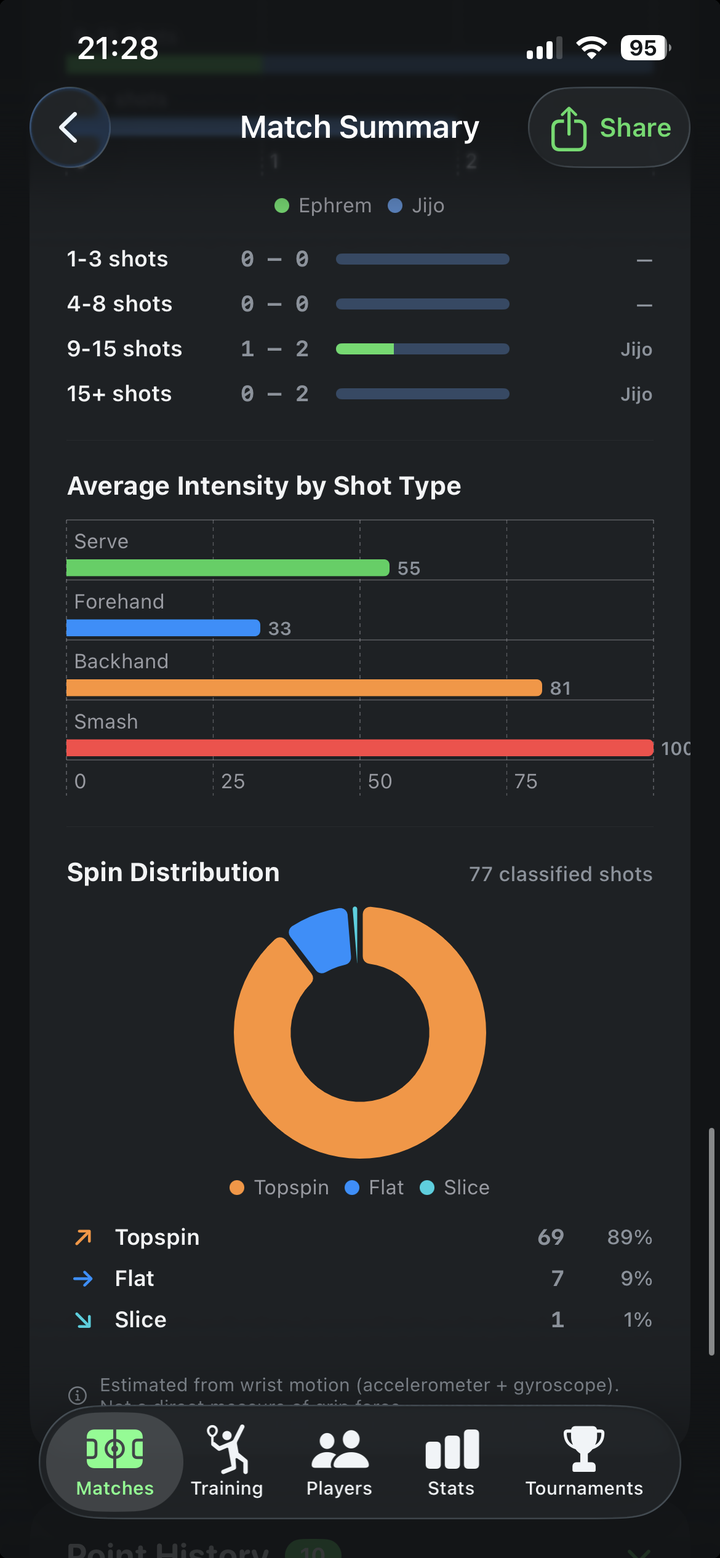
Average intensity per shot type
The Match Summary includes a bar chart comparing how hard you hit each shot type. In the screenshot on the left — a real demo match — smashes peak at 100, backhands at 81, serves at 55, and forehands at 33. Your profile will look different: that's the point.
- Compare your forehand intensity to your backhand — is one arm doing all the work?
- Track serve intensity over time to see if your fatigue is eating into your power.
- Padel players: slice and drop classification is especially useful — these make up most of the match. Bandeja and vibora are also detected from their distinct shoulder-and-wrist motion.
- Beach Tennis players: classification follows the tennis path (not padel), which fits paddle-style swings on sand better — serves, forehands, backhands, smashes and slices all detected from the same wrist motion.
- Badminton players: a dedicated badminton path runs on the Watch. A serve window opens at the start of every rally and only the current server's stroke is labelled as Serve; once the rally is live, classification switches to forehands, backhands, smashes, drops, slices and lobs. The current server stays synchronised between iPhone and Watch in real time.
Get CourtsidePlay
Every feature on this page is built in. Download once and start analysing your next match.